Staging the American Dream: How Your Living Room Became a Set and You Became the Unpaid Art Director
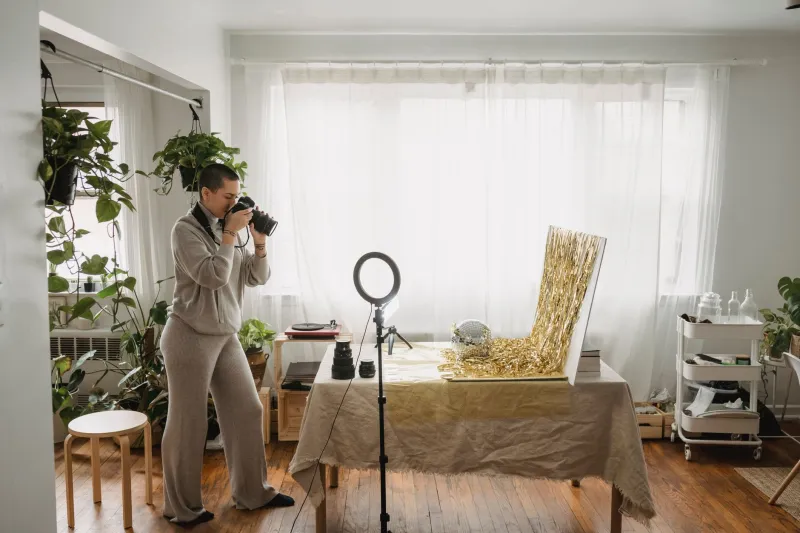
There is a moment — a specific, crystallizing moment — when you realize something has gone deeply wrong. Maybe it happened when you caught yourself rearranging the fruit bowl before your mother-in-law's visit, not for her benefit, but because you wanted the photo you'd take afterward to look more intentional. Maybe it was when you spent forty-five minutes on Etsy searching for a linen napkin that would make your dining table look like it belongs to someone who has their life together. Or maybe — and this is the one that really stings — it was when you looked at your perfectly functional, comfortable couch and thought, this doesn't say anything about me as a person.
Congratulations. Your home is now a content set. The crew has gone home. You are both the director and the talent, and you are working around the clock for free.
The HGTV-to-TikTok Pipeline That Ate Your Equity
This didn't happen overnight, and it didn't happen without help. We had accomplices. HGTV spent the better part of two decades convincing middle America that a kitchen renovation was less a practical undertaking and more a spiritual calling — that the correct countertop material was the difference between a life well-lived and one wasted in quiet beige despair. Then came Instagram, which shrank the aspiration down to a 1080x1080 square and made it feel achievable. Then came TikTok, which made it feel urgent.
The result is a content ecosystem so saturated with #homeinspo, #roomtour, and #interiordesign content that the algorithm has essentially become a very pushy real estate agent who lives inside your phone and will not stop showing you open concept floor plans. You didn't ask for this. You were just trying to find a recipe. Now you're watching a woman in Nashville install shiplap in her mudroom and feeling genuinely bad about your own mudroom, which until thirty seconds ago you had no opinions about whatsoever.
This is the pipeline. You enter at "I just want some ideas" and exit at a Wayfair cart with $2,300 worth of items you're financing over twelve months.
Every Room Must Perform
What's remarkable — and by remarkable I mean genuinely alarming — is how completely the logic of aesthetic performance has spread through the entire home. It used to be that you kept the living room presentable for guests and let the rest of the house exist in honest, human chaos. The bedroom was yours. The laundry room was a crime scene. The garage was where hope went to die among unused exercise equipment.
Not anymore.
Now the bedroom needs a "moment" — a gallery wall, a rattan headboard, a strategically draped throw that looks casual but took eleven attempts to position correctly. The laundry room gets a shiplap accent wall and matching detergent dispensers decanted into amber glass bottles, because apparently even the act of doing laundry must be aesthetically coherent. And the garage? The garage now has floor coating. Epoxy floor coating. In a color. With little metallic flakes in it. Because someone on YouTube told a hundred thousand people that a garage floor could be a personality trait, and a hundred thousand people believed them.
The domestic space has been fully colonized by the logic of content creation, and the lease you signed said nothing about this.
The Furniture Flipping Economy and the Dopamine That Comes With It
Here's where it gets economically interesting, or economically horrifying, depending on your relationship with your credit card statement. The pressure to maintain an aesthetically current home has spawned an entire secondary market built on the premise that your furniture has a shelf life roughly equivalent to a seasonal trend. Facebook Marketplace is now a graveyard of nearly-new sofas, accent chairs that were in style for approximately one fiscal quarter, and console tables that committed the unforgivable sin of being purchased in 2021.
People are not buying furniture anymore. They are cycling furniture. Acquiring, staging, photographing, listing, and replacing — an endless churn that serves the content calendar and absolutely nothing else. The sofa isn't worn out. The sofa is just no longer the right sofa for who you are trying to be this season.
The furniture industry, predictably, has adapted to accommodate this. Fast furniture — the IKEA-adjacent, assembly-required, structurally optimistic category of home goods — now arrives at your door in two days and is designed to look great in photos and disintegrate within eighteen months, at which point you will need to buy more furniture to photograph. It is the fast fashion model applied to the objects you sit on, and it is generating landfill content at a pace that would make a sustainability researcher weep into their aesthetically pleasing reusable water bottle.
Comfort as an Afterthought
The truly insidious part of all this isn't the money, though the money is significant. It's what gets quietly deprioritized when the primary metric for a home is how it photographs.
Comfort, for one. There is an entire category of furniture — you know exactly which chairs I'm talking about — that exists purely to be looked at. Sculptural chairs. Accent chairs. Chairs that are chairs only in the loosest philosophical sense. Nobody sits in them. They sit in the corner like expensive art that also technically functions as seating if you are willing to accept lower back consequences. They look incredible in a flat lay. They are an act of aggression against the human spine.
Personality, for another. The dominant aesthetics of the current moment — quiet luxury, Japandi minimalism, coastal grandmother, whatever micro-trend crested on Pinterest last Tuesday — are by definition shared aesthetics. They are moods that thousands of people are performing simultaneously. Your home, decorated to trend, looks like everyone else's home decorated to trend, which means you have sacrificed your actual taste on the altar of algorithmic approval and ended up with a space that is aesthetically coherent and spiritually hollow.
The Room That Didn't Need to Be Content
Somewhere in America right now, someone is pressure-washing their driveway at 7 a.m. on a Saturday to prep for a Reel about their curb appeal refresh. Someone else is stress-shopping for the correct shade of sage green to repaint a room that was painted last spring in a color they were equally convinced about at the time. Someone is buying a neon sign for their home bar — the home bar they built specifically because home bars were a thing people were doing — that says something like "Good Vibes Only" or "But First, Cocktails," because the bar needed something for the wall, and the wall needed something for the photo.
Your home does not owe the internet anything. Your couch does not need to make a statement. Your garage floor does not need to be a personality. These are radical positions in the current climate, and I understand if you need a moment.
But maybe — just maybe — the most subversive thing you can do in 2025 is let one room in your house be genuinely, unabashedly, unphotographably yours. Messy. Comfortable. Off-trend. Unposted.
The algorithm will not reward you for this. Your lower back will.