The Appliance That Judges You: Your Smart Home Is Watching and It Has Noted the Leftover Pizza
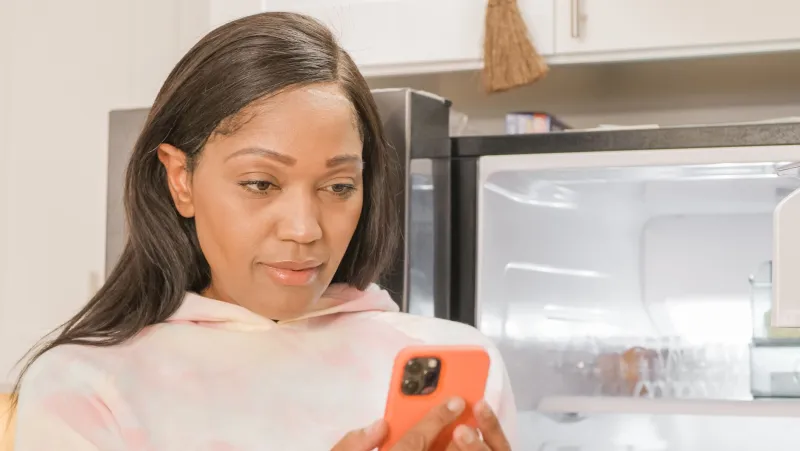
The refrigerator in the Samsung commercial does not judge you. It offers gently, with a soft chime and a touch screen interface, to help you "plan your week" and "reduce food waste." It suggests recipes based on what's inside. It lets you check its contents remotely, from the grocery store, so you never have to wonder if you need more eggs. It is, in the commercial, a gracious and helpful companion on your journey toward a more organized life.
In reality, it is a $3,800 data collection device with a very cold interior.
Welcome to the Internet of Things That Know Too Much
The smart home was sold to us as convenience, and it is convenient — in the same way that having a very attentive personal assistant is convenient, if you are comfortable with that assistant reading your mail, logging your schedule, and periodically selling your behavioral data to advertising partners you've never heard of.
The connected home ecosystem now includes refrigerators that track your food inventory, sleep trackers embedded in mattresses, thermostats that learn your schedule, doorbells that record your movements, washing machines you can control from your phone, and ovens that can be preheated on your commute home. Each of these devices collects data. Each of those data streams is, to varying degrees, a revenue source for the companies that make them.
The average American smart home generates approximately 150 gigabytes of data per day, according to some estimates. That is a lot of information about whether you remembered to close the garage.
The Refrigerator Is Not Your Friend
Let's spend some time with the smart fridge, because it is the most clarifying example of how the connected appliance industry operates. Samsung's Family Hub refrigerator, LG's InstaView, and their various competitors offer a genuinely impressive suite of features: internal cameras, expiration date tracking, shopping list integration, streaming services on the door panel (yes, you can watch YouTube on your refrigerator, which is either the future or a sign that we've made a serious wrong turn somewhere).
What the marketing materials are less forthcoming about is what happens to the data these appliances collect. Samsung's privacy policy — which, like all privacy policies, is designed to be technically readable and practically incomprehensible — allows the company to share information with "service providers, business partners, and other third parties" for purposes including "marketing and advertising." The internal cameras that photograph your shelves to help you shop more efficiently are also, in a very real sense, a window into your household's consumption habits. That information has commercial value.
So when your smart fridge notices that you've been buying a lot of oat milk and the Greek yogurt has been sitting on the same shelf for three weeks, that observation does not stay between you and your appliance. It enters a data ecosystem that connects to advertisers, insurers, and the broader surveillance infrastructure of contemporary consumer capitalism. Your refrigerator's observations about your eating habits could, in theory, influence the ads you see, the insurance rates you're quoted, and the algorithmic profile that various companies have assembled about you.
The fridge is not judging you. It is, however, filing a report.
Privacy Settings for Your Ice Maker
Here is a sentence that would have sounded like science fiction in 2005: you now need to review the privacy settings on your kitchen appliances.
This is the reality of the smart home. Every connected device comes with a terms of service agreement that almost no one reads, a privacy policy that almost no one understands, and a default configuration that is almost always maximally permissive with your data. Opting out — to the extent that opting out is even possible — requires navigating a settings menu that was clearly designed by someone who does not want you to find it.
The Amazon Echo in your living room is, by default, always listening for its wake word. The Ring doorbell is recording footage that Amazon has, in the past, shared with law enforcement without a warrant. Your Nest thermostat is building a behavioral profile of your household that Google uses to improve its services — and define "improve" however you'd like. Your Roomba, until iRobot reversed course following public outcry, was mapping the interior of your home with the stated intention of eventually selling that data.
You have, in the pursuit of a slightly more convenient life, invited a surveillance apparatus into your home and given it access to your kitchen.
The Convenience Bargain You Didn't Fully Read
The thing is, the convenience is real. Being able to preheat your oven from the parking lot is genuinely useful. A thermostat that learns your schedule and adjusts automatically saves energy and money. A doorbell that shows you who's outside without getting up is, objectively, a small improvement in daily life.
The problem is not the utility of these devices. The problem is the terms under which that utility is provided, and the way those terms are obscured behind friendly interfaces and cheerful product names. "Smart" home devices are not primarily sold as data collection tools — they are sold as quality-of-life upgrades. The data collection is the business model, and it is buried in paragraph fourteen of the user agreement.
This is the fundamental bargain of the surveillance economy, applied now to your kitchen: you receive a service for free or at a reduced cost, and in exchange you provide behavioral data that is worth more, in aggregate, than whatever discount you received. The smart home just extends this bargain into the most intimate space you occupy.
Your home used to be the one place where you were not being watched. Now it's the most thoroughly instrumented room in your life.
The Algorithm Has Suggestions About Your Sodium Intake
The next frontier — and this is not speculation, it is already in development — is the smart home as health management system. Refrigerators that track your nutritional intake and sync with your health insurance provider. Scales that report to your doctor. Sleep trackers that adjust your premium based on your rest quality. The connected home as a continuous health monitoring device, with your insurance company as the silent audience.
Some of this is presented as empowering. You'll have data about your own habits! You can make better choices! What is less discussed is who else has access to that data, and what they plan to do with it. A refrigerator that knows you eat poorly is valuable to a health insurer in ways that are not necessarily in your interest.
The smart home promised to make your life easier. It delivered on that promise in the same way that any good surveillance system makes things easier: by removing friction, by anticipating your needs, by becoming indispensable — and by learning, in the process, everything about you.
Your refrigerator is not judging the leftover pizza. But somewhere, an algorithm has noted it, filed it, and added it to a profile that is growing more complete every time you open the door.
The ice maker has no opinion on any of this. The ice maker just makes ice. The ice maker, frankly, is the only appliance in your home you can still trust.