Twelve Ways to Pay for Your Milk and Zero Ways to Feel Good About It
There was a time — not so long ago, geologically speaking — when buying a gallon of milk required approximately one decision: which register had the shortest line. You handed a human being some money. They gave you change. Nobody's produce was flagged as a potential security threat. It was, in retrospect, paradise.
That paradise is gone. In its place stands the modern American supermarket checkout experience, which now offers somewhere between eight and fourteen distinct ways to complete a transaction, none of which feel particularly correct, all of which involve at least one moment of soul-crushing public humiliation.
The Illusion of Autonomy, Presented in Lane Form
Walk into any major grocery chain today and you will be confronted with what can only be described as a choose-your-own-adventure novel written by someone who hates you. There's the traditional staffed lane — three of them, one of which has a light on but no cashier, and one of which is express-only, a designation enforced with the moral authority of a neighborhood watch sign. Then there's the self-checkout bank: a row of twelve identical kiosks, eight of which are operational, two of which have a blinking yellow light that means something nobody can explain, and one of which still has a receipt dangling from the previous customer like a flag of surrender.
Beyond that: the app-based scan-as-you-shop lane, which requires you to have downloaded the store's proprietary app, created an account, verified your email, and agreed to terms of service that are almost certainly longer than the Constitution. And finally — because why stop at overwhelming — the staffed express lane that technically accepts full orders on weekends but only if the manager on duty feels generous.
This is not choice. This is choice cosplay.
The Weight Sensor Is Judging You
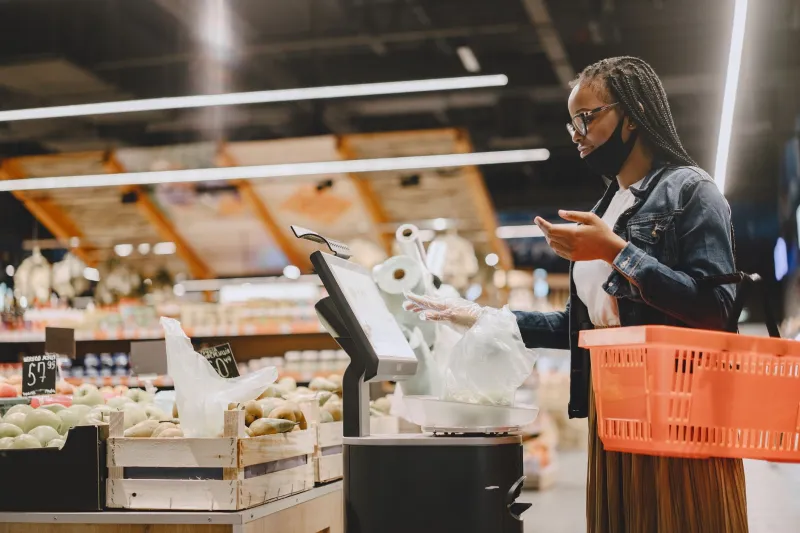
If you've made the bold decision to use a self-checkout kiosk, congratulations. You have agreed to work a retail shift for free in exchange for the privilege of not making small talk. The machine will now walk you through a process that assumes you are simultaneously a shoplifter, an idiot, and someone who has never before encountered a barcode.
Place your item in the bagging area. The bagging area does not recognize your item. Please wait for assistance. An attendant — one person responsible for monitoring all twelve kiosks simultaneously, like an air traffic controller at a particularly chaotic regional airport — will eventually arrive, wave a badge, and restore order without making eye contact. You will feel vaguely guilty for a crime you did not commit.
The produce situation deserves its own congressional inquiry. You have a bag of apples. The screen wants you to look up the PLU code. You can search by name, by category, or by image — a feature that confidently identifies your Honeycrisp as a Red Delicious and charges you accordingly. If you brought loose green onions, God help you. You will be standing at that kiosk until the onions decompose naturally.
Loyalty Programs: The Toll Booth You Forgot You Signed Up For
At some point during your checkout odyssey, the machine — or the human cashier, or the app — will ask if you have a rewards account. This is not a casual question. This is the moment the whole transaction pivots. Without your loyalty number, the rotisserie chicken is $11.99. With it, $6.99. The store is not offering you a discount. The store is charging non-members a penalty for having privacy preferences, and calling it savings.
The rewards app itself has, at last count, four separate ways to "activate deals" before you shop, none of which are intuitive, and a points system that converts to cash rewards at a ratio that requires a spreadsheet to evaluate. One major chain recently introduced a paid premium tier of its loyalty program — a subscription, naturally — that unlocks better discounts than the free tier, meaning you now pay monthly for the opportunity to save money on groceries you were already buying. The circle is complete. The ouroboros has scanned itself and placed itself in the bagging area.
The Staffed Lane Is Not the Retreat You Think It Is
Perhaps you've decided to opt out of the whole digital gauntlet and simply use a staffed checkout lane, the way your parents did, the way their parents did, the way humans have exchanged currency for goods since the invention of the register. Reasonable. Dignified, even.
Except the staffed lane now also asks if you found everything okay (you did not, but you will say yes), whether you want to donate a dollar to a charity the corporation has pre-selected (you will feel like a monster if you say no), whether you want to sign up for the store credit card (the cashier is required to ask this and they are just as tired of it as you are), and whether your phone number is associated with an account. The human cashier is, at this point, a very warm interface for the same loyalty database you were trying to avoid.
Also: they will tell you your total and then the machine will tell you your total and then the screen will show you your total and then it will ask you to confirm your total, and at no point will any of these totals feel like the number you expected.
More Options, More Problems, Same Milk
What the grocery industry has engineered — whether intentionally or through the compounding chaos of competing tech vendors and loyalty platform integrations — is a checkout experience that expands to fill all available anxiety. The options do not reduce friction. They distribute it across a wider surface area so that no single moment is catastrophic, but the cumulative weight of micro-decisions leaves you exhausted by the time you reach the parking lot.
This is, of course, by design. A distracted, slightly overwhelmed customer is a customer who doesn't comparison-shop, doesn't scrutinize the shrinkflated package size, and definitely doesn't notice that the store-brand item they usually buy has been subtly relocated to the bottom shelf while the premium option glows at eye level like a small commercial sun.
The milk is still milk. It costs more than it did last year. You paid for it in three steps, two taps, and one moment of existential uncertainty in front of a weight sensor.
Welcome to the future of retail. Please place it in the bagging area.