The Bathroom Shelf as Archaeological Site: A Field Guide to Products You Bought During a Crisis
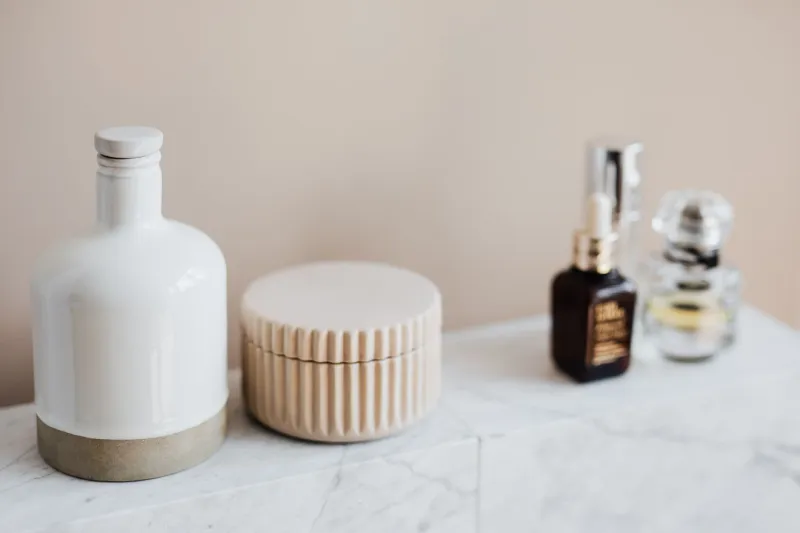
If a future civilization were to excavate the average American bathroom cabinet, they would conclude that we were a people of extraordinary aspiration and remarkably poor follow-through. They would find, preserved under a light film of dried serum and good intentions, the complete material record of every wellness trend that swept through the internet between 2018 and now. They would find products in three stages of use: unopened, opened-once, and mostly-empty-but-kept-because-you-might-finish-it-eventually.
They would not find rest. Rest doesn't leave artifacts.
Stratigraphy of the Modern Wellness Cabinet
Let's go layer by layer, as any good archaeologist would.
The bottom layer — the deepest, most ancient stratum — contains the retinol phase. This was when you read that retinol was the only thing that actually worked, which was alarming because you had spent the previous two years buying things that did not contain retinol. You bought the retinol. You used it for six weeks, got frustrated when your skin didn't transform, and then read that you needed to use it for six months minimum to see results. You did not use it for six months. The retinol is still there, 70% full, sitting next to a vitamin C serum that oxidized in 2021.
Above that, the hyaluronic acid era. Then the niacinamide era. Then the ceramide era, which overlapped briefly with the peptide era, which is currently ongoing and shows no signs of resolution. Each layer represents not just a product but a moment of hope — a specific evening when you were tired and stressed and a targeted ad or a TikTok appeared and said, with the confidence of a doctor and the credentials of neither, that this was the thing you'd been missing.
The Device Graveyard
But the serums are just the sediment. The real monuments are the devices.
There is, in many American bathrooms, an LED light therapy mask. It looks like a prop from a low-budget science fiction film. It cost between $200 and $500. The box claims it stimulates collagen production, reduces inflammation, and improves skin tone. You used it for approximately two weeks, during which time you sat in your bathroom looking like a malfunctioning robot, wondering whether you were doing it right, and feeling vaguely self-conscious even though you were alone. Then you stopped. The mask is in its box. The box is on the shelf. The shelf is becoming a monument.
There is also a gua sha stone. Or possibly a jade roller. Or both, because at some point the algorithm decided you needed both and you were not in a position to argue. These require a specific kind of commitment — not just time, but ritual. You have to want to spend seven minutes doing a thing with a cold rock in a particular pattern for results that are, at best, subtle and, at worst, indistinguishable from just having slept well. You did not, as it turns out, want this. But you did want the idea of this, which is why you bought it.
The microneedling roller is in the back. We don't have to talk about the microneedling roller.
The Psychology of the Purchase as Action
Here's what the wellness industry figured out — and to be clear, this is genuinely clever in a way that should make you furious — is that buying a self-care product feels, in the moment, almost identical to performing self-care. The act of purchasing creates a small, satisfying sense of having done something. You identified a problem. You researched solutions. You made a decision. You took action.
Except the action was the purchase. The actual thing — the nightly routine, the seven-minute gua sha ritual, the twice-weekly LED session — that part never quite happened. Because that part requires time and consistency and the willingness to do a boring thing repeatedly without immediate reward, and those are exactly the things you didn't have enough of when you bought the product in the first place.
The industry knows this. The scarcity countdown timers on the product pages — only 3 left in stock! — are not about inventory. They're about bypassing the part of your brain that would otherwise ask whether you're actually going to use this. The limited edition drops, the "routine building" kits, the subscription boxes that arrive monthly with new products before you've finished the old ones — all of it is designed to keep you in the acquisition phase, where the feeling of doing something is most accessible.
Actual self-care — sleeping eight hours, drinking water, going outside, doing nothing on purpose — is free. It doesn't ship. It doesn't have a rewards program. It cannot be photographed for a shelfie. The industry has correctly identified this as a gap in the market and filled it with $45 facial mists.
The Ritual That Never Became a Routine
Every product on that shelf came with a routine attached to it. AM routine. PM routine. Weekly treatment. Monthly reset. The language of skincare has become the language of productivity systems — layered, sequenced, optimized, and completely unsustainable for any person who also has a job, a family, and a finite number of hours before they simply need to be unconscious.
The 12-step Korean skincare routine that swept the internet a few years ago was not inherently unreasonable. It was unreasonable for the specific life conditions of most American consumers, who are tired in a way that goes beyond skincare and into something structural that no amount of essence is going to address. But the routine arrived with its own aspirational lifestyle attached — calm mornings, organized shelves, the gentle satisfaction of a completed sequence — and the products were more purchasable than the lifestyle, so that's what people bought.
The shelf is full. The routine never started. The face is fine.
An Honest Accounting
If you were to add up what's sitting on that shelf — the serums, the devices, the tools, the treatments — the total would probably be somewhere between $400 and $1,200 for the average enthusiast. Maybe more if you went through a particular phase during a particularly difficult year, which, statistically, most of us did.
None of it is making you feel better. Not because the products are all bad — some of them probably work — but because the shelf itself is now a source of low-grade guilt. Every time you walk past the LED mask in its box, something in you registers it as a small failure. The things you bought to reduce stress are now, gently but persistently, adding to it.
The most radical self-care move available to you right now might be donating the gua sha stone, recycling what's expired, and going to bed twenty minutes earlier.
It won't photograph as well. But your face — and more importantly, the rest of you — might actually notice.